Pages

Friday, September 29, 2017

The Eyes Have It

A medium-sized brown butterfly called a Little Wood-Satyr seems to show up everywhere, at least in the eastern US. It is just about as common as the Common Wood-Nymph, and I would consistently confuse the two as they fluttered across our fields in Pennsylvania. So when a brown butterfly with eye spots showed up in our tiny yard in Massachusetts, it was time to figure out what distinguishes the two--and it seems to be the eye spots. The Little Wood-Satyr (which was the visitor I saw)


has two large eye spots on each forewing and hindwing, and so I focused on those eye spots in my weekly block:

But those two tiny white dots in the center of each eye are intriguing as well, although they don't seem to figure in the identifying process. And then there are the lines on butterfly wings that zig and zig and arc and curve--and that I love to add to my design.

It is satisfying to reach clarity on something in this confusing world, even if it is as insignificant as a brown butterfly.

And, if you are still reading, thanks for the company!

Linking with Nina's Off the Wall Friday!

Tuesday, September 26, 2017

My Favorite Color


Just had to celebrate the success of the few plants I transplanted last year. Turtleheads always make me smile because they are so aptly named. And this is just one patch. They love this shady, very damp place, where it looked like only jewel weed (and its companion plant that will not be named) would grow. 

And if an art lesson is to be learned, aside from just the beauty of these flowers, it is that, if you keep trying, you will find what works, whether it's a piece you are getting frustrated with--or your life. Don't give up on the difficult places.

Friday, September 15, 2017

Flies That You Don't Want to Swat

I have had even more reason not to be keeping up with my insect journey since I have been on a different journey--to New Brunswick and Nova Scotia, where I renewed my spirit with scenes like these:


But I did manage to put the finishing touches on a few insect squares. The first was inspired by a Longlegged Fly that caught my eye on the bottom of Tom's kayak:


This guy gleams iridescent green with even more gold highlights than the camera picked up. There are many, many species of these flies that survive by eating other smaller insects (yay!) so I couldn't identify it more specifically, but the wing patterns are distinctive. So I took the opportunity to put some gilt foil on some fabric, something I haven't done in a while, and then tried to capture that rather Celtic-looking pattern on the wings.


And then another fly showed up serendipitously as we were eating breakfast on our deck one morning. It was unsuccessfully trying to hide under the top of the railing--a Summer Fishfly. These are quite common around ponds but I had never seen one before because they are nocturnal and usually more successful in finding a good spot big enough to accommodate their three inches during the day.


The larvae of these guys live several years in the water eating little bugs and even tadpoles. But look at the patterning on the veins of the wings. I thought at first its antennae were feathered but that would have meant it was a moth of some kind. Instead on closer inspection I discovered the antennae were pectinate (a new word for me, and obviously for my spell checker, since it is objecting)--like the teeth of a comb.


And now back to unpacking and catching up on things in Massachusetts.

I am linking to Off the Wall Friday.


Friday, September 1, 2017

Under Milkweed

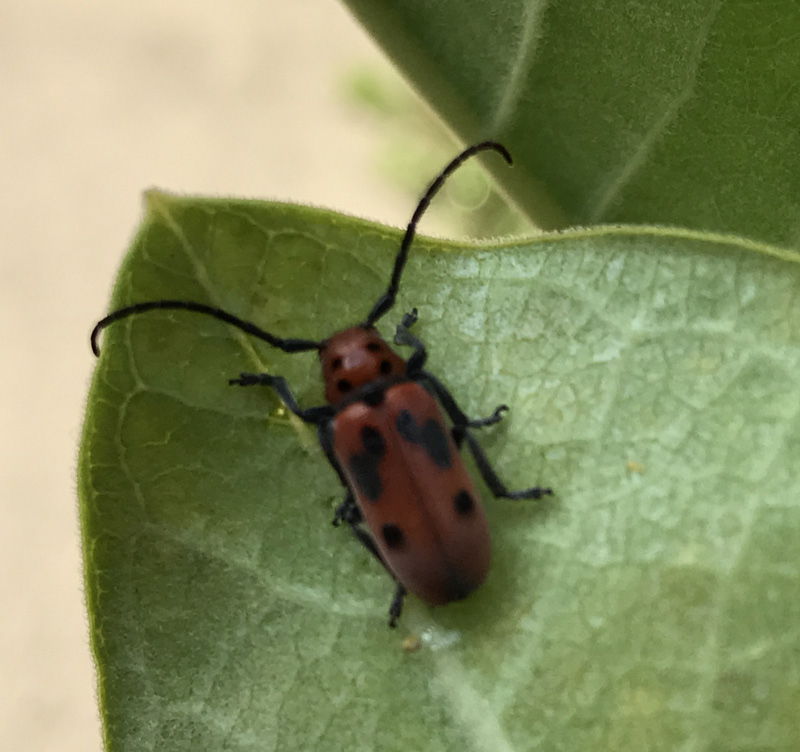
I was searching the milkweed plants in front of the Joppa Flats Mass Audubon Education Center for any critters to show families on a Meet the Insects event when I happened upon this guy, who has a lot of visual impact, as they say in the art world.


This is a Red Milkweed Beetle so he was definitely in the right place. He belongs to the family of long-horned beetles, for obvious reasons. I was fascinated by those antennae and by the patterning those matching legs created.


I had to add that bright orangy-red color (which is actually closer to his true color than my photo) that advertises to potential predators that this guy has been feeding on the same thing that monarch do and might not taste so good.

And I am linking, while it is still Friday, to Off the Wall Friday.

Friday, August 25, 2017

More Winged Things

I didn't quite get a 5-inch square finished last week and I can blame the wonderful distraction of having old friends visit for much of the week. But they renewed my spirit, which was much more important than keeping to a schedule.

Luckily, I am way behind in posting about my already completed insect squares, so I have plenty to write about. I chose the next in the series not because of its beauty or complexity but because of its simplicity and ubiquity. The Cabbage White Butterfly is one of the most easily recognized, but I found myself having a problem creating an interesting block. The Cabbage White is not pure white (it can even have a yellow glow to its hindwing) but sports one (male) or two (female) smudgy black spots on the upper wing along with a black smudge on the top corner of that wing. Easy, I thought.

I just didn't like this. So a couple of weeks later I went back and added a black line for that black body that separates the wings.


This is still not my favorite block but I like it better. Perhaps it is echoing my feelings for the butterfly itself--not my favorite and it even caused me to think some destructive thoughts when I was growing a lot of vegetables, but I enjoy seeing it now.

My next block was also somewhat common around here but is new to me and is quite dramatic when you see one.

This is a Common Whitetail Dragonfly, a large member of this family. And perhaps I was overcompensating for the plainness of the previous week with the glittery overlay on this block, but I think it does capture what I wanted to capture.


So if you are still reading, thanks for the company--and hope you, too, have enjoyed the company of well loved friends this summer.

I am linking with Nina Marie. Check out what other fiber artists are doing!


Sunday, August 6, 2017

A Good Way to Spend an Afternoon

Yesterday I got a surprise. I went to the opening of the Contemporary Art Quilts Show at the Whistler House Museum of Art in Lowell (MA)--a beautiful show that I was honored to be juried into. And here are a few of the impressive works:
Channeling Ernst Haeckel 3 by Sandy Gregg

Three Figures by Valerie Maser-Flanagan
Growth Factor by Betty Busby

I was enjoying catching up with some other artists I had not seen in a bit--particularly an old friend who I had not seen in several years when it was announced that awards were to be presented: a juror's award from Wen Redmond that went to Poseidon by Marilyn Belford, and two Whistler awards, given by the director of the gallery, one of which went to Queen Bee by Nancy Turbitt and the other to my piece, Insight! Congratulations to my fellow award winners!

Poseidon by Marilyn Belford

Queen Bee by Nancy Turbitt


Insight (my piece)

It was quite a day!


Friday, July 28, 2017

Insect beauties

No creepy crawlies posted this week--just a butterfly and a moth that are both easy to love. As part of an overnight adventure at our house, I took my granddaughter to the Butterfly Place in Westford, MA, in the late spring, a magical place where colors and shapes flutter around you and sometimes land on your arm. Although I have been trying to keep my insect project limited to those that live around here, I couldn't resist adding just one, even though its home is in the tropics.


This is a Common Birdwing that had a distinctive design on its hind wing, which became the basis of my block a couple of weeks ago.


In early April I took a quiet walk in Maudslay Park, a 400+ acre estate formerly owned and enjoyed by a very few people, now owned by a forward-thinking state so that many can walk its winding paths. The spring frogs were vocalizing but I saw few insects until a bit of orange caught my eye among the leaf litter. It was a moth, quite active for the daylight hours. On investigating further at home, I discovered it to be Archiearis infans, also called The Infant, one of the first moths to show up in the spring. 

And so I had to celebrate it in some way.


I am realizing now that the orange in the photo of my block is reading a bit redder than the actual fabric. So just imagine the orange triangle as closer in color to the moth's hind wings.

And, if you are still reading about my adventures with the six-legged creatures, thanks for the company!

Linked with Off the Wall Fridays.